

Care Sector Guide
Door Repairs for Care Homes
CQC-relevant fire door compliance, DDA-compliant and automatic entrances, access control and 24/7 emergency callouts — explained for care home managers and facilities staff across the North West of England.
Get a Care Home Door Repair Quote
Tell us about your site and we'll get back to you fast.
Doors in a care home are doing a different job to almost any other commercial building. They're protecting residents who can't always move quickly, opening for people who can't always push hard, and standing between a safe, secure environment and the outside world — often all at once. When one jams, drags, or fails to close properly, it's not just an inconvenience, it's a fire safety and safeguarding issue. Here's what door repairs for care homes actually involve, and what to expect from a specialist across the North West.
Why Care Homes Need a Different Approach to Door Repairs
A care home isn't like an office or a shop. Fire doors, bedroom doors and internal corridor doors are opened and closed constantly by staff moving between residents, by trolleys and hoists, and by residents themselves — often with less care or awareness of how a door should be treated. That level of use, combined with the added weight of DDA-compliant hardware and self-closers set to the right tension, means faults develop faster than in a typical commercial building.
On top of the wear, care homes carry obligations a standard office simply doesn't. Residents are on site 24 hours a day, many cannot evacuate quickly in an emergency, and the building itself is regularly inspected against national care standards, not just fire safety law. A generic repair might get a door working again for now — it won't necessarily meet those requirements, and it won't necessarily hold up under scrutiny.
Fire Door Compliance in Care Homes and CQC Inspections
Care homes are covered by the same Regulatory Reform (Fire Safety) Order 2005 as any other non-domestic building, with the registered manager typically acting as the "Responsible Person" for fire safety. But there's a compliance angle here that's more direct than in most sectors: the Care Quality Commission (CQC) examines fire doors and general building safety as part of its inspection process, particularly under the Safe key question. A fire door that's been wedged open, has a disconnected self-closer, or shows a damaged intumescent seal isn't just a hazard waiting to happen — it's the kind of finding that can affect the home's CQC rating, not only create a safety risk.
That's what sets door repairs for care homes apart from almost any other commercial sector: the standard of your fire doors is being assessed by both a fire risk assessor and a CQC inspector, and the two overlap. Our fire door regulations guide covers the wider legal detail in full, and our steel fire exit door servicing covers inspection, repair and certification for exactly this kind of fault.
Not sure if your care home's fire doors would pass inspection?
We'll survey every fire door on site and tell you exactly where you stand before CQC does.
Compartmentation and "Defend in Place"
Many care home residents cannot self-evacuate quickly because of mobility issues, dementia or being bed-bound, so evacuating the whole building the moment a fire alarm sounds simply isn't realistic in the way it might be for an office. The standard approach in care settings is known as "defend in place" — using fire doors and compartmentation to contain a fire within one area of the building, while residents nearby are moved a short distance to another compartment rather than evacuated outside entirely.
This only works if every fire door along the compartmentation line actually does its job: closing fully, latching properly, and holding back smoke and flame for its rated time. A single fire door propped open with a fire extinguisher, or a self-closer that's been disconnected because it was "too stiff", can undermine the whole strategy for that section of the building. It's a good reason why fire door maintenance in a care home carries more weight than a like-for-like repair in a typical commercial property.
DDA-Compliant and Automatic Doors as a Baseline
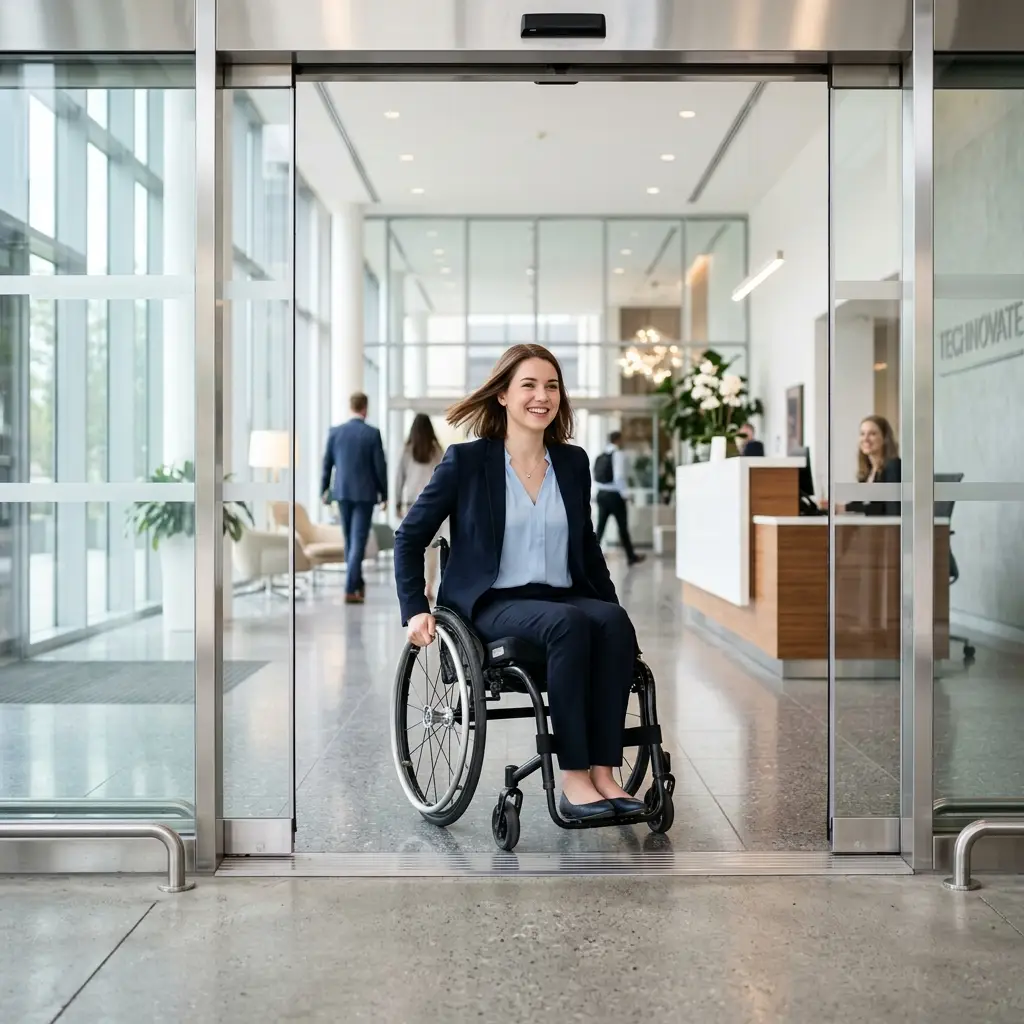
In most commercial buildings, an automatic or DDA-compliant door is a nice-to-have at the main entrance. In a care home, it's close to a baseline requirement. A significant proportion of residents use wheelchairs or walking frames, and many simply don't have the strength to push open a heavy fire-rated door unassisted — a genuine barrier to independence, and a real safety issue if staff aren't nearby to help.
- Automatic entrance doors. Main entrances and communal areas benefit from automatic sliding or swing doors that operate safely around residents using mobility aids, serviced to BS EN 16005, the safety standard covering sensor performance and safe operation around pedestrians.
- DDA-compliant doors. Under the Equality Act 2010, reasonable adjustments are expected for residents, staff and visitors with disabilities — our DDA-compliant doors service and automatic entrance door installations cover this directly.
- Access control systems. Fob, keypad and buzzer entry protecting the main entrance and sensitive internal doors, covered in our access control door installations.
Security, Access Control and Preventing Unsupervised Exits
Access control in a care home has to work in two directions at once. It needs to keep unauthorised visitors out, protecting vulnerable residents from anyone who shouldn't be on site. But it also, in many homes, needs to help prevent residents living with dementia from leaving the building unsupervised and coming to harm — a genuinely different consideration from the security setup in an office or a retail unit, and one that needs handling sensitively and factually rather than as an afterthought.
In practice, that usually means keypad or fob-controlled doors at key exit points, sometimes paired with delayed-egress hardware or discreet alarms on doors leading outside, alongside a fire strategy that still allows those doors to open freely in a genuine emergency. Getting that balance wrong in either direction — too restrictive, or not restrictive enough — is a real risk, which is why access control repairs and upgrades in a care home are worth treating as specialist work rather than a standard lock fix.
Working Around Residents, Not an Empty Building
Unlike a school or nursery, a care home never empties out. Residents are on site every hour of every day, which means there's no quiet closure period to schedule work into and no holiday window to fall back on for bigger jobs. Repairs have to be planned around residents' routines instead — avoiding mealtimes, quiet periods, and times when a corridor or communal door is in heavy use for moving residents between rooms.
That also means working quietly and considerately. Drilling, hammering or leaving tools and materials in a corridor can be disorientating or distressing for residents, particularly those living with dementia, so a good contractor will plan the work, contain the mess, and keep noise and disruption to a minimum throughout. And because the occupants are more vulnerable than in almost any other commercial setting, emergency response time matters even more here — a fire exit that won't open, or a main entrance that won't lock, needs attending to in hours, not days, whatever time it happens.
A stuck fire exit or failed door closer in a care home is a same-day problem. With residents on site around the clock, there's no window where it's acceptable to leave a fire door or entrance faulty overnight. Our 24/7 emergency door repairs cover exactly this kind of urgent fault, any time of day or night.
What to Look for in a Care Home Door Repairs Contractor
Given the compliance and safeguarding weight behind door repairs for care homes, it's worth being more selective than for a standard trade callout. Before booking anyone in, check they can offer:
- CSCS registration or equivalent, confirming a recognised standard of competence on a construction/site environment.
- Experience with occupied care settings, not just retail or office premises — the pace, noise sensitivity and safeguarding expectations are genuinely different.
- Fire door certification knowledge, so repairs don't accidentally invalidate a door's fire rating or undermine compartmentation.
- DDA and automatic door expertise, since so much of a care home's day-to-day access relies on doors working correctly for residents with limited mobility.
- A genuine 24/7 emergency callout service, because with residents on site around the clock, a faulty fire exit or entrance simply can't wait for normal working hours.
Get a fixed quote for your care home
Fire doors, DDA-compliant entrances and access control — scheduled around residents, not against them.
Door Repairs for Care Homes Across the North West
BJM Door Solutions provides door repairs for care homes across Greater Manchester, Cheshire, Lancashire and Merseyside — from single-site residential homes to larger nursing and dementia care facilities. Whether it's a fire door that wouldn't pass a CQC inspection, a DDA-compliant entrance that's stopped opening for residents, or an access control system that isn't doing its job properly, our CSCS-registered engineers work to fix it properly, quietly, and with the right paperwork on file for your next inspection.
Common Questions
Care Home Door Repair FAQs
Who provides door repairs for care homes in the North West?
BJM Door Solutions provides door repairs for care homes across Greater Manchester, Cheshire, Lancashire and Merseyside, covering fire doors, DDA-compliant and automatic entrances, access control and 24/7 emergency callouts. Look for a CSCS-registered installer with experience of occupied care settings, since residents are on site around the clock and fire doors are directly scrutinised by CQC inspectors.
Do care home fire doors affect a CQC inspection?
Yes. Fire doors and general building safety are examined directly as part of a CQC inspection, particularly under the Safe key question. A fire door that's been wedged open, has a failed self-closer or a damaged seal isn't just a safety risk — it can be flagged during inspection and affect the home's rating, so keeping fire doors properly maintained is a compliance matter as much as a safety one.
Why is compartmentation so important in a care home?
Many care home residents cannot self-evacuate quickly because of mobility issues, dementia or being bed-bound, so the standard approach is "defend in place" — using fire doors and compartmentation to contain a fire in one area while residents are moved a short distance rather than evacuated from the whole building. That only works if every fire door in the compartmentation line closes and seals properly, which is why routine door maintenance matters more in a care home than in most commercial settings.
Do care home doors need to be DDA compliant and automatic?
Almost always, yes. With most residents using wheelchairs, walking frames or having limited strength to push a heavy door, DDA-compliant and automatic doors at entrances and key internal routes are close to a baseline requirement in a care home rather than an optional extra, alongside duties under the Equality Act 2010.
How quickly can a jammed fire exit or entrance door be fixed at a care home?
Given the vulnerability of the residents on site, a stuck fire exit, a failed self-closer or an entrance door that won't lock should be treated as an emergency callout, not a routine repair. A 24/7 emergency response service should be able to attend within hours, at any time of day or night, since care homes never have a quiet closure period.
Get Started
Ready to Get Your Care Home's Doors Sorted?
Contact BJM Door Solutions today for a fixed, no-surprises quote on door repairs for care homes across the North West. Our CSCS-registered engineers work around your residents, not against them.
Get a Free Quote