

Healthcare Sector Guide
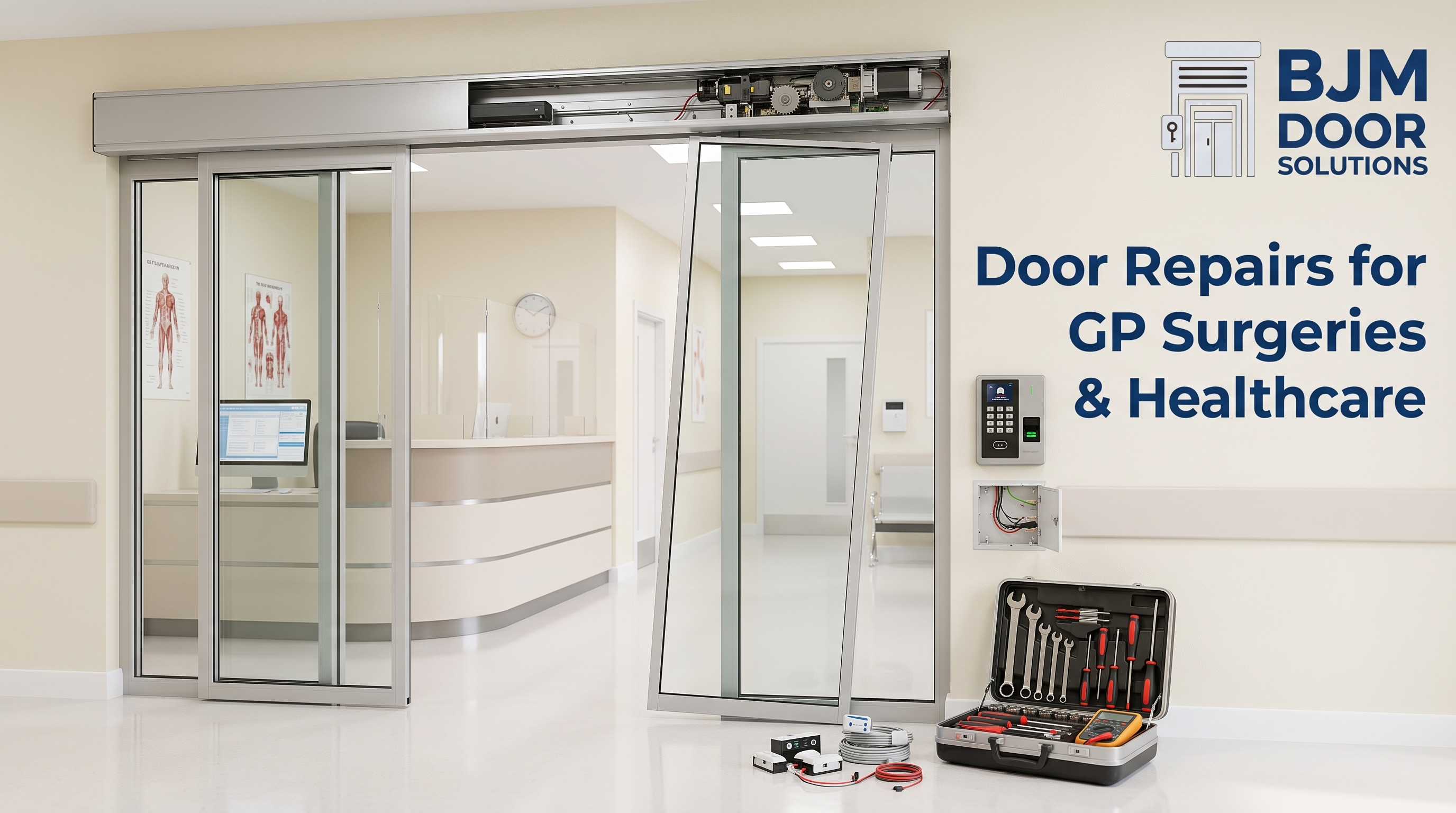
Door Repairs for GP Surgeries & Healthcare
Automatic entrance doors, DDA compliance, fire door safety and emergency callouts — explained for practice managers and estates staff at surgeries and healthcare buildings across the North West of England.
Get a Surgery Door Repair Quote
Tell us about your site and we'll get back to you fast.
A GP surgery's front door works harder, and matters more, than the entrance to almost any other building. Every patient who comes through it may be unwell, elderly, using a wheelchair, pushing a pram, or leaning on a frame — and a heavy door that won't open easily isn't just inconvenient, it can genuinely stop someone getting the care they need. Door repairs for GP surgeries need to be treated with that in mind. Here's what's involved, and what to expect from a specialist across the North West.
Why Healthcare Buildings Need a Different Approach
A retail unit or office deals with a fairly able-bodied, able-fit footfall. A GP surgery deals with the opposite: a population weighted towards exactly the people who find a standard manual door hardest to use. Add in wheelchairs, mobility scooters, prams, walking frames, crutches and patients who are simply too breathless or unwell to push hard against a closer spring, and the entrance door stops being a minor fixture and becomes part of the clinical experience.
On top of that, healthcare premises carry obligations a standard commercial building doesn't. Surgeries registered with the Care Quality Commission (CQC) are expected to keep their premises safe and accessible as a condition of registration, which extends to entrance doors, fire doors and any barrier that could affect a patient's safety or ability to access care. A quick bodge that gets a door working again for a week doesn't meet that bar — it needs doing properly, by someone who understands the sector.
Door Repairs for GP Surgeries: Why Automatic Entry Matters Most Here
If there's one point that sets healthcare apart from every other sector we work in, it's this: automatic entrance doors aren't a nice-to-have at a GP surgery, they're close to essential. A patient with breathing difficulties, a hip replacement, or a heavy frame simply may not be able to push open a standard manual or spring-closed door unaided — and unlike a shop, there's rarely a member of staff standing right there to help. Step-free, sensor-operated automatic entry removes that barrier entirely, which is exactly why automatic entrance doors are so common at surgery and clinic entrances.
There's also a genuine infection control angle that's become far more prominent since the pandemic. A shared manual door handle, pushed and pulled by every patient walking in and out of a building full of unwell people, is a straightforward route for cross-contamination. Touchless automatic doors remove that shared contact point altogether, which is one of the reasons so many practices have moved away from manual entrances in the years since.
Automatic entrance stuck, slow, or not sensing properly?
We'll get it back to safe, reliable operation for your patients.
DDA and Equality Act Compliance
Under the Equality Act 2010, any healthcare premises open to the public has a legal duty to make reasonable adjustments for patients, staff and visitors with disabilities. For a GP surgery this isn't a box-ticking exercise — it's a hard requirement, because the population walking through the door is, by definition, weighted towards people who need those adjustments most. A main entrance that's step-free and openable without excessive force is the practical minimum expected, which is why so many practices fit DDA-compliant doors alongside or instead of a standard manual entrance.
Automatic doors at a surgery entrance also need to meet BS EN 16005, the safety standard governing sensor performance and safe operation around pedestrians. That matters even more here than in a typical retail setting, given how many patients using the entrance may move more slowly, use mobility aids, or be accompanied by a carer.
Fire Door Compliance in Healthcare Buildings
GP surgeries and healthcare buildings fall under the same Regulatory Reform (Fire Safety) Order 2005 as any other non-domestic building, with the practice manager or a nominated responsible person typically holding that duty. But the stakes are higher than in a standard office. Fire doors provide compartmentation — they hold back fire and smoke long enough for people to get out safely — and in a building where some patients have reduced mobility and cannot self-evacuate quickly, every fire door on site needs to be closing, latching and sealing correctly, without exception.
A fire door wedged open for airflow, a self-closer that's been disconnected, or a damaged intumescent seal is a compliance failure regardless of what its original certificate says. Our fire door regulations guide covers the wider legal detail, and our steel fire exit door servicing covers inspection, repair and certification for exactly this kind of fault.
Working Around Clinic Hours
Unlike a school or an office, a GP surgery rarely has a quiet week or a holiday shutdown. Most practices run continuous clinic sessions from early morning through to evening, with reception covering the entrance the entire time, which makes scheduling door repairs a genuinely different problem to solve. In practice, most repairs at a healthcare site fall into one of three windows:
- Between clinic sessions — the gap between morning and afternoon surgery is often the best window for work that needs the entrance briefly out of use.
- Out of hours — early morning before reception opens, or evenings once the last appointment has finished, for larger jobs like an automatic door replacement or an access control upgrade.
- Genuine emergencies — an entrance that's stuck shut, stuck open, or a fire exit that won't release can't wait for a quiet moment and needs treating as a same-day callout.
Any contractor working at a surgery should be coordinating directly with the practice manager, keeping disruption to reception and patient flow to an absolute minimum, and understanding that a working entrance isn't optional for even a single clinic session.
A jammed entrance or fire exit at a healthcare building is a patient safety issue, not just a maintenance job. If a door won't open, won't close, or won't lock, that needs sorting the same day. Our 24/7 emergency door repairs cover exactly this kind of urgent fault.
What to Look for in a Healthcare Door Repairs Contractor
Given the compliance and patient safety angle, it's worth being more selective than you would for a general trade callout. Before booking anyone in for door repairs at a GP surgery or healthcare building, check they can offer:
- CSCS registration or equivalent, confirming a recognised standard of competence on a construction/site environment.
- Experience with automatic and DDA-compliant entrances, not just standard manual doors — the equipment and safety standards involved are different.
- Fire door certification knowledge, so repairs don't accidentally invalidate a door's fire rating.
- Flexible scheduling around clinic sessions and reception hours, not a fixed nine-to-five.
- A genuine emergency callout service for the days an entrance or fire exit simply can't wait.
Get a fixed quote for your practice
Automatic entrances, DDA compliance and fire doors — scheduled around your clinic hours.
Door Repairs for GP Surgeries Across the North West
BJM Door Solutions provides door repairs for GP surgeries, dental practices and healthcare buildings across Greater Manchester, Cheshire, Lancashire and Merseyside — from single-partner practices to larger primary care centres. Whether it's an automatic entrance that's stopped sensing patients properly, a fire door that's failed inspection, or an access control system protecting a reception desk, our CSCS-registered engineers work to fix it properly, around your clinic hours, and keep the right paperwork on file for CQC and your fire risk assessment. See our access control door installations page for securing staff-only areas alongside a fully accessible public entrance.
Common Questions
GP Surgery Door Repair FAQs
Who provides door repairs for GP surgeries in the North West?
BJM Door Solutions provides door repairs for GP surgeries and healthcare buildings across Greater Manchester, Cheshire, Lancashire and Merseyside, covering automatic entrance doors, fire doors, DDA compliance and emergency callouts. Look for a CSCS-registered installer with experience working around occupied clinical sites, since patient safety and continuous opening hours change how the work needs to be scheduled.
Do GP surgery entrance doors need to be automatic or DDA compliant?
Yes. Under the Equality Act 2010, any healthcare premises open to the public must make reasonable adjustments for patients with disabilities, and a GP surgery serves a higher proportion of people with mobility issues than almost any other building type. Step-free, automatic entry that opens without the patient needing to push or pull is treated as the practical standard, not an optional extra.
Why do healthcare buildings use automatic doors instead of manual ones?
Automatic doors remove the need for patients with mobility issues, breathlessness, a walking frame or crutches to push open a heavy manual door, which matters far more in a surgery than in a typical shop or office. Touchless automatic entry also reduces cross-contamination from a shared door handle, which is a genuine infection control consideration in any clinical setting.
Can door repairs be carried out while a GP surgery is open?
Yes, most routine door repairs can be scheduled around clinic sessions, during quieter parts of the day, or out of hours to avoid disrupting reception and patient flow. Any work on the main entrance or a fire exit should be coordinated with the practice manager in advance so cover can be arranged for that period.
How quickly can a stuck entrance or fire door be fixed at a healthcare building?
A jammed automatic entrance or a fire exit that won't open is treated as an emergency callout in a healthcare setting, because it directly affects patients who may not be able to self-evacuate quickly or get into the building unaided. A same-day or 24/7 emergency repair service should be able to attend within hours.
Get Started
Ready to Get Your Surgery's Doors Sorted?
Contact BJM Door Solutions today for a fixed, no-surprises quote on door repairs for GP surgeries across the North West. Our CSCS-registered engineers work around your clinic hours.
Get a Free Quote