

Industrial & Logistics Guide
Door Repairs for Warehouses Explained
Steel fire exit doors, roller shutters and loading bay doors — explained for warehouse and distribution centre managers across the North West of England.
Get a Warehouse Door Repair Quote
Tell us about your site and we'll get back to you fast.
A warehouse door doesn't get a quiet life. Forklifts, pallet trucks, loading bay traffic and hundreds of goods movements a day put a different kind of stress on doors and shutters than you'd see in a shop or office — and when something fails, it's rarely just an inconvenience. Here's what door repairs for warehouses actually involve, and what to expect from a specialist across the North West.
Why Warehouses Need a Different Approach to Door Repairs
An office door might open a few dozen times a day. A warehouse fire exit on a busy pedestrian route, or a loading bay shutter cycling every time a lorry arrives, can see that much use before lunchtime. That level of traffic — often combined with forklifts, pallet trucks and heavy goods passing through — means doors and shutters in this sector wear out faster and take a harder impact than almost anywhere else in commercial property.
Because of that, steel construction isn't an upgrade for a warehouse door, it's the standard starting point. Timber or lightweight composite doors simply don't hold up to daily forklift traffic, loading bay knocks and heavy footfall in the same way. Anyone repairing doors on an industrial or logistics site needs to understand that difference from the outset, not treat it like a standard commercial callout.
Fire Door Compliance for Warehouses and Distribution Centres
Warehouses are covered by the same Regulatory Reform (Fire Safety) Order 2005 as any other non-domestic building, with the employer or building owner typically acting as the "Responsible Person". In a warehouse, that duty usually centres on large compartmentation doors separating different storage zones, plus fire doors along pedestrian and forklift escape routes — all of which need to be properly maintained and inspected as part of the site's fire risk assessment.
Because of the volume of daily traffic, steel fire exit doors are the norm rather than the exception on a warehouse site, and they need servicing on a schedule that reflects real-world wear, not a generic annual tick-box visit. Our fire door regulations guide covers the wider legal detail in full, and our steel fire exit door servicing covers inspection, repair and certification for exactly this kind of high-traffic door.
Not sure if your warehouse's fire doors would pass inspection?
We'll survey every fire door on site and tell you exactly where you stand.
Roller Shutters and Loading Bay Doors
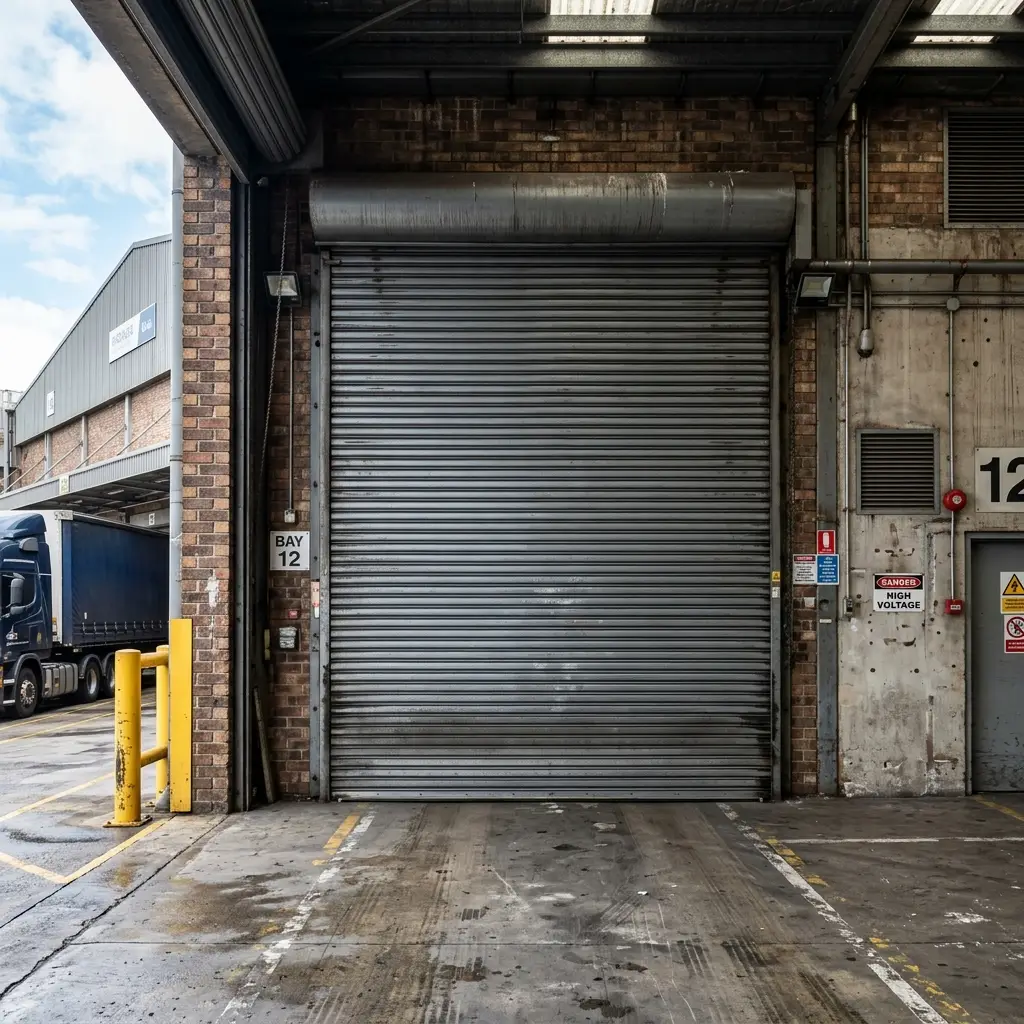
Roller shutters are where most warehouse door repair work actually happens. Loading bay shutters take a battering from daily lorry and van traffic, while external security shutters protect the building outside operating hours — and both fire-rated and standard security shutters need to be kept in proper working order, not just left running until they seize up.
- Loading bay shutters. High-cycle doors that open and close constantly through the working day, covered by our security roller shutters installation service and our dedicated roller shutter repairs for faults on existing shutters.
- External security shutters. Protecting the building and stock outside operating hours — these need regular checks on the motor, guide rails and locking mechanism to stay reliable.
- Staff and visitor entrances. Many warehouses also run a smaller automatic or manual entrance for office staff and visitors alongside the industrial doors — see our automatic commercial door installations if that's part of your site too.
There's also a compliance angle that's specific to powered shutters and doesn't apply to a standard fire door: the Provision and Use of Work Equipment Regulations 1998 (PUWER). Because a powered roller shutter is work equipment, PUWER requires it to be suitable for its use, properly maintained, and inspected at suitable intervals, with records kept. That's a separate legal duty from fire door regulations, and it's worth checking your contractor understands the distinction.
Working Around Shift Patterns and Operations
Most warehouses and distribution centres don't get a quiet "closed" period the way a shop or office does. Many run multiple shifts, and plenty run 24/7 — which means there's rarely a natural window to shut a loading bay down for repairs without it costing someone something. In practice, door repairs for warehouses tend to fall into three categories:
- Routine repairs around shift changeovers — the natural lull between outgoing and incoming shifts, when a bay or entrance sees less traffic.
- Planned maintenance in quieter windows — scheduled between peak despatch times, agreed in advance with the warehouse or operations manager.
- Genuine emergencies — a stuck loading bay shutter or a blocked fire exit needs attending the same day, whatever shift happens to be running when it fails.
That last point matters more here than almost any other sector. A warehouse with a stuck loading bay shutter isn't just facing a safety or security issue — it can halt goods in and goods out completely, which affects despatch targets, courier collection slots and inbound deliveries. Every hour a bay is down is an hour of real operational cost, not just an inconvenience to schedule around.
A blocked fire exit or a stuck loading bay shutter is a downtime problem as well as a safety one. On a site running shifts around the clock, that's not something to log and wait on. Our 24/7 emergency door repairs cover exactly this kind of urgent fault, whatever time it happens.
What to Look for in a Warehouse Door Repairs Contractor
Given the compliance requirements and the cost of downtime, it's worth being selective about who you bring onto an active warehouse site. Before booking anyone in for door repairs for warehouses, check they can offer:
- CSCS registration or equivalent, confirming a recognised standard of competence on a construction/industrial site.
- Experience with steel fire doors and industrial roller shutters, not just standard commercial doors — the equipment and the wear patterns are genuinely different.
- Knowledge of both fire door regulations and PUWER, so repairs meet both duties rather than just one.
- Flexible scheduling around shift changeovers, not just a standard nine-to-five callout window.
- A genuine emergency response for the days a loading bay shutter or fire exit simply can't wait, given what downtime actually costs.
Get a fixed quote for your warehouse
Steel fire doors, roller shutters and loading bay doors — scheduled around your shift patterns.
Door Repairs for Warehouses Across the North West
BJM Door Solutions provides door repairs for warehouses and distribution centres across Greater Manchester, Cheshire, Lancashire and Merseyside — from single-unit storage sites to larger logistics hubs running round-the-clock shifts. Whether it's a steel fire exit door that's failed inspection, a loading bay shutter that's jammed mid-cycle, or a security shutter that won't lock down at the end of the day, our CSCS-registered engineers work to fix it properly, keep the right paperwork on file, and get your site moving goods again with minimum downtime.
Common Questions
Warehouse Door Repair FAQs
Who provides door repairs for warehouses in the North West?
BJM Door Solutions provides door repairs for warehouses and distribution centres across Greater Manchester, Cheshire, Lancashire and Merseyside, covering steel fire exit doors, roller shutters and loading bay doors. Look for a CSCS-registered contractor with experience of high-traffic industrial sites and genuine 24/7 emergency cover, since a stuck shutter or blocked fire exit is a downtime problem as much as a safety one.
What fire door regulations apply to warehouses and distribution centres?
Warehouses fall under the Regulatory Reform (Fire Safety) Order 2005, with the employer or building owner acting as the Responsible Person. Fire doors used for compartmentation between warehouse zones and along forklift and pedestrian escape routes must be maintained and inspected as part of the site's fire risk assessment, and given the heavier daily wear in this sector, steel construction is the standard rather than an upgrade.
Do warehouse roller shutter doors need to meet PUWER regulations?
Yes. Powered roller shutters and loading bay doors count as work equipment under the Provision and Use of Work Equipment Regulations 1998 (PUWER), which is separate from fire door regulations. That means shutters need to be suitable for their use, properly maintained, and inspected at suitable intervals, with records kept to show the duty has been met.
How much does a stuck loading bay shutter cost a warehouse in downtime?
It varies by site, but a blocked loading bay can halt goods in and goods out entirely, which quickly affects despatch targets, courier slots and inbound stock. For most distribution operations that makes a stuck shutter a same-day emergency rather than something to schedule in for next week.
Can door and shutter repairs be carried out on a 24/7 warehouse site?
Yes. Routine repairs can usually be scheduled around shift changeovers or quieter periods between shifts so they don't interrupt active picking, packing or loading. Genuine faults affecting a fire exit or a loading bay shutter should be treated as an emergency callout and attended the same day, regardless of what shift is currently running.
Get Started
Ready to Get Your Warehouse Doors Sorted?
Contact BJM Door Solutions today for a fixed, no-surprises quote on door repairs for warehouses across the North West. Our CSCS-registered engineers work around your shift patterns.
Get a Free Quote